RCB post-processing
Test before you invest!


Menno Logmans
Area Sales Manager
The Hosokawa Group has developed a complete process for the sustainable recovery of carbon black (rCB) from used tyres. By performing a number of steps after pyrolysis, the process results in dust-free granular material that can be dosed accurately. It is immediately suitable for reuse in tyre production and other rubber-based applications.
Many recyclers that handle car tyres are keen to find a way to recover carbon black from the rubber. Our integrated rCB processing line transforms this ‘black gold’ into consistent, top-quality rCB—ready for dosing, storage and downstream use—supporting circular manufacturing and reducing reliance on virgin carbon black.
Integrated Process
This process was developed through close cooperation between several companies in the Hosokawa Group – including Hosokawa Alpine, Hosokawa Micron and Hosokawa Solids Solutions – in combination with proven equipment and many years of experience. Thanks to the close coordination of all machines and process steps, recycling companies benefit from a consistently efficient complete system with only one point of contact.
rCB-finishing
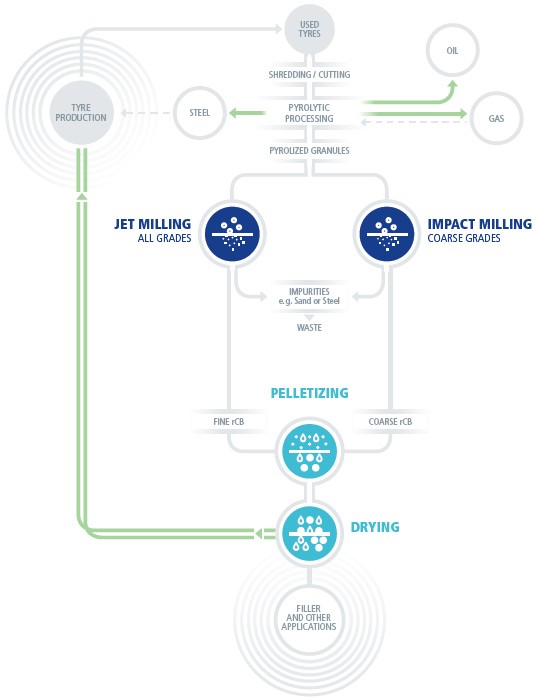
After tyres are shredded and treated by pyrolysis, oils and gases are recovered for reuse, while the remaining solid fraction forms the basis for rCB finishing. To meet the strict requirements of tyre manufacturers, the particle structure of this material must be precisely modified. Hosokawa’s rCB process converts the pyrolysed material into a granular product with controlled particle size, improved flowability and minimal dust formation, making it suitable for storage, transport and downstream use.
Fine Grinding of rCB
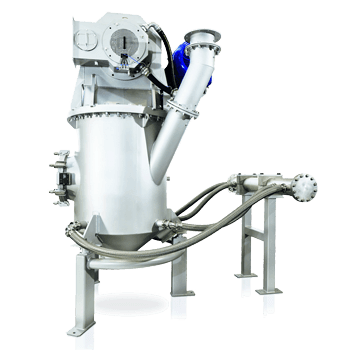
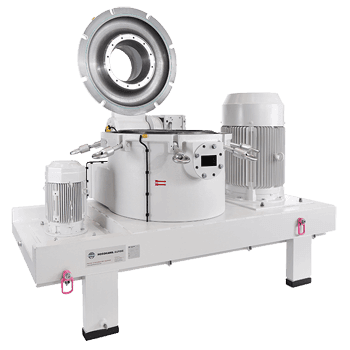
Fine grinding is a key step in achieving the desired rCB quality. Depending on the target fineness, ash content and abrasiveness of the material, Hosokawa Alpine offers different milling technologies. Fluidised bed opposed jet mills enable ultra-fine grinding with sharp particle size distribution while facilitating the removal of residual metallic impurities. For coarser rCB grades, mechanical classifier mills provide an energy-efficient alternative with reliable performance. The choice of technology ensures an optimal balance between product quality and operating costs.
 |  |
Handling
It is not unusual for grinding lines to have a capacity of 1 ton/hour or more. Bearing in mind that the bulk density of the ground product is approximately 80–120 grams per litre, the process can soon involve volumes of more than 10 m³/hour. At this stage, the Carbon Black is a dusty material with poor flow properties and a tendency to settle. Here, the specific expertise of Hosokawa Solids Solutions comes into play, supplying systems for the trouble-free transfer of the semifinished material between the various process steps.
Agglomeration and Pelletising
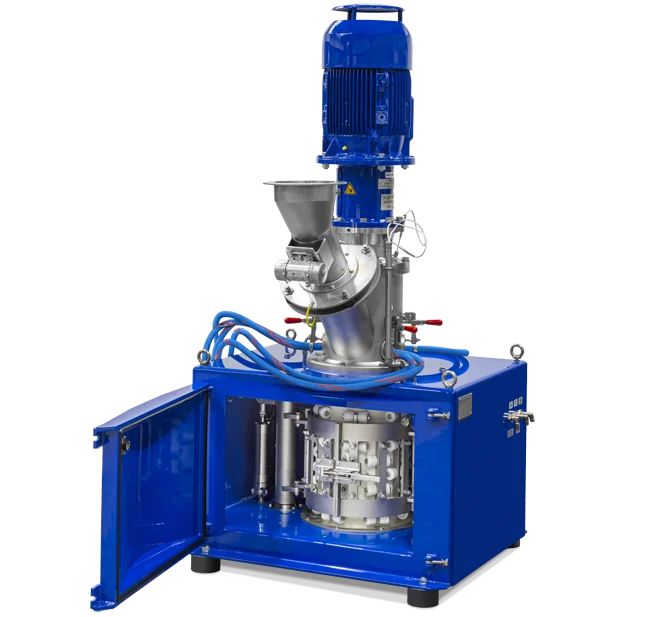
After fine grinding, the rCB powder is agglomerated and dried—two core competencies of Hosokawa Micron. Continuous agglomeration can be performed using the Flexomix high-speed mixer, where rCB is dosed with a precisely controlled amount of binder, typically water. The flexible mixing chamber prevents material build-up, producing uniform, moist granules at the outlet.
Alternatively, agglomeration can be carried out using a Pin Mixer from our partner Mars Mineral. This horizontal high-shear mixer forms dense, spherical granules with high mechanical strength, suitable for pneumatic conveying. Both Flexomix and Pin Mixer systems operate continuously and deliver consistent granule quality.
Drying and Cooling
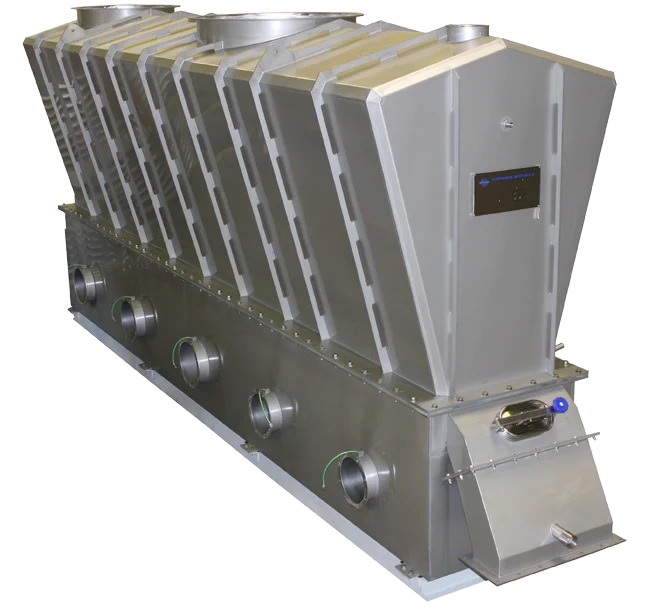
The freshly agglomerated material is dried in a specially designed, static fluid-bed dryer positioned directly downstream of the mixer. Hot air is evenly distributed through the product bed to remove residual moisture, after which the granules are gently cooled. This ensures thermal stability, uniform moisture content and a final product that meets the requirements for safe storage, packaging and reuse in rubber compounds.
Test Before You Invest
Run trials with your own materials on production-scale equipment at our 2,000 m² Test & Process Development Centre in the Netherlands. Our experienced process specialists work with you to determine the optimal process, equipment or plant setup. We offer lab and production-scale trials, each supported by a detailed technical report covering setup, process parameters and performance insights—helping you choose the best solution with confidence.