What does the Mullins Effect mean and how to measure it?
The Mullins effect is the stress-softening observed in rubber when it is loaded for the first time to a given strain. On subsequent loadings to the same strain, the rubber shows lower stress.
Once “damaged” by a prior stretch, the rubber never quite goes back to its original stiffness.
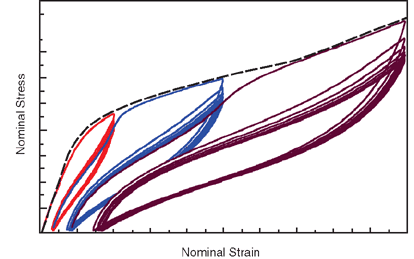
Image from: https://abaqus-docs.mit.edu/2017/English/SIMACAEMATRefMap/simamat-c-mullins.htm
What’s happening?
Unlike the Payne effect (filler network breakdown at small cyclic strains), the Mullins effect involves large deformations and changes inside the rubber matrix itself:
Key mechanisms include:
Breakage of weak polymer–filler bonds
Slippage or rearrangement of polymer chains
Micro-damage in the filler–rubber network
Possible chain scission at very high strains
After the first loading:
Some internal structure is permanently altered
Reloading follows a softer stress–strain path
The effect depends on the maximum strain previously experienced
How it appears experimentally
In a uniaxial tensile test:
First loading → high stress
Unloading → hysteresis (energy loss)
Reloading to same strain → lower stress curve
Loading beyond previous maximum strain → stiffness increases again until a new “damage level” is reached
This creates a characteristic stress–strain loop.
Key characteristics
Strain-history dependent
Partially irreversible
Occurs in filled and unfilled rubbers, but is much stronger in filled systems
Strongly tied to energy dissipation (hysteresis)
Why it matters in real applications
The Mullins effect impacts:
Dimensional stability
Fatigue life
Sealing performance
Load–deflection behavior
First-cycle vs in-service properties
Examples:
Rubber seals feel “softer” after initial installation
Tires experience property changes after first use
Vibration isolators shift stiffness after commissioning
Factors that influence the Mullins effect
Filler content and type
Quality of filler dispersion
Polymer–filler interaction strength
Maximum strain level
Temperature
Strain rate
Unlike the Payne effect, resting the material does not fully restore the original stiffness.
Mullins vs. Payne (side-by-side)
Feature | Mullins Effect | Payne Effect |
|---|---|---|
Strain level | Large | Small to moderate |
Loading type | Quasi-static or cyclic | Dynamic oscillatory |
Reversibility | Mostly irreversible | Largely reversible |
Main cause | Polymer/filler damage | Filler network breakdown |
Typical test | Tensile loading | DMA / RPA strain sweep |
Modeling the Mullins effect
Common approaches in constitutive models:
Damage mechanics models
Pseudo-elastic models (e.g., Ogden–Roxburgh model)
Energy-based softening formulations
These are essential in finite element analysis of rubber components.


Disclaimer
Please be aware that the content on our website is provided for general informational purposes only and should not be interpreted as binding or professional advice. The information presented here is not a replacement for tailored, legally binding advice suited to specific circumstances. Although we make every effort to ensure the information is accurate, up-to-date, and reliable, we cannot guarantee its completeness, accuracy, or timeliness for any particular use. We are not responsible for any damages or losses that may result from relying on the information provided on our website.